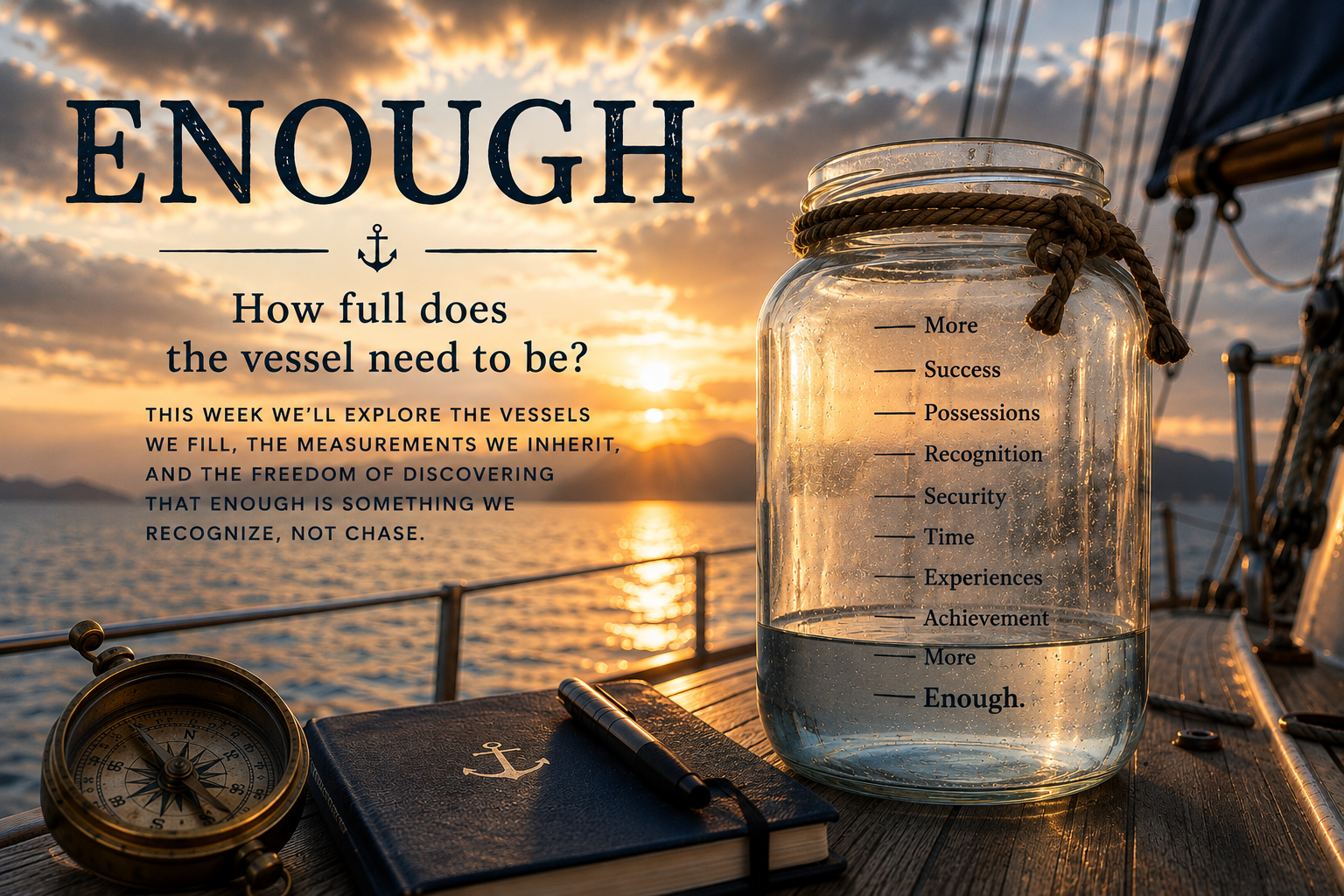
There is a dangerous little word hiding inside much of modern life.
More.
More money.
More possessions.
More recognition.
More followers.
More security.
More experiences.
More accomplishments.
Even more time.
We live much of our lives with a vessel held out in front of us, waiting for the next thing to be poured into it.
And perhaps we should begin this week with a simple question:
How will we know when the vessel is full?
The Problem Isn’t More
I don’t believe ambition is the enemy.
I have spent too much of my life chasing horizons to suddenly pretend there is virtue in having no desire to see what lies beyond the next one.
There is satisfaction in building something.
There is joy in learning.
There is purpose in improving ourselves, testing our limits, accepting challenges, and occasionally discovering that we are capable of considerably more than we thought.
There is nothing inherently wrong with more.
The trouble begins when we have never defined enough.
Because without enough, more has no finish line.
Different Vessels
I suspect we spend much of our lives carrying different vessels.
One for money.
One for possessions.
One for achievement.
One for recognition.
One for love.
One for security.
One for knowledge.
Some are nearly full.
Some have holes in the bottom.
And some we continue pouring things into long after they already contain everything we actually need.
Maybe that’s why enough is such an interesting idea.
Enough depends upon the vessel.
A sailor doesn’t complain that his coffee cup cannot hold a gallon. The cup was never meant to hold a gallon.
Yet we rarely extend ourselves the same courtesy.
We compare the size and fullness of our vessels with everyone else’s and begin wondering whether ours ought to contain more.
Someone has a larger house.
Someone has more money.
Someone has traveled farther.
Someone has accomplished more.
Someone has more people applauding them.
So we pour a little more into ours.
And then a little more.
Rarely stopping to ask whether we were thirsty in the first place.
Who Decided What Enough Looks Like?
That may be one of the questions worth carrying around this week.
How much is enough?
But perhaps even more importantly:
Who taught us the answer?
Family?
Culture?
Advertising?
Our friends?
Our neighbors?
The fellow with the bigger boat tied up at the next dock?
Somewhere along the way, many of us inherited measurements we never consciously chose.
Success looks like this.
Security requires that.
Happiness comes after achieving this other thing.
And we dutifully begin filling our vessels accordingly.
Enough Isn’t Settling
This distinction matters.
Enough does not mean quitting.
It doesn’t mean abandoning ambition.
It doesn’t mean refusing opportunity or deciding that growth no longer matters.
Enough simply means recognizing that this moment does not have to be incomplete because something else might happen tomorrow.
I can appreciate the harbor without giving up my desire to sail.
I can enjoy what I have without promising never to pursue anything else.
I can be content and curious at the same time.
Maybe that’s one of the great misunderstandings about contentment.
We treat it as the opposite of ambition.
Perhaps it isn’t.
Perhaps contentment simply allows ambition to become a choice rather than a hunger.
This Week
So that’s where we’re going.
We’ll look at the vessels we spend our lives filling.
We’ll talk about money and possessions.
Achievement and recognition.
Time and attention.
Relationships.
Expectations.
Maybe even the strange tendency we human beings have to keep pouring after the cup is already overflowing.
And somewhere along the way, perhaps we’ll discover that enough isn’t something waiting for us at the end of the journey.
Maybe it is something we learn to recognize along the way.
There will always be another horizon.
There will always be another thing we could acquire, accomplish, experience, or become.
That’s part of what makes life interesting.
But every once in a while, it might be worth looking at the vessel already in our hands.
Not to ask whether it could hold more.
But simply to notice what is already there.
This is sufficient for this moment.
Tomorrow?
We can sail again.