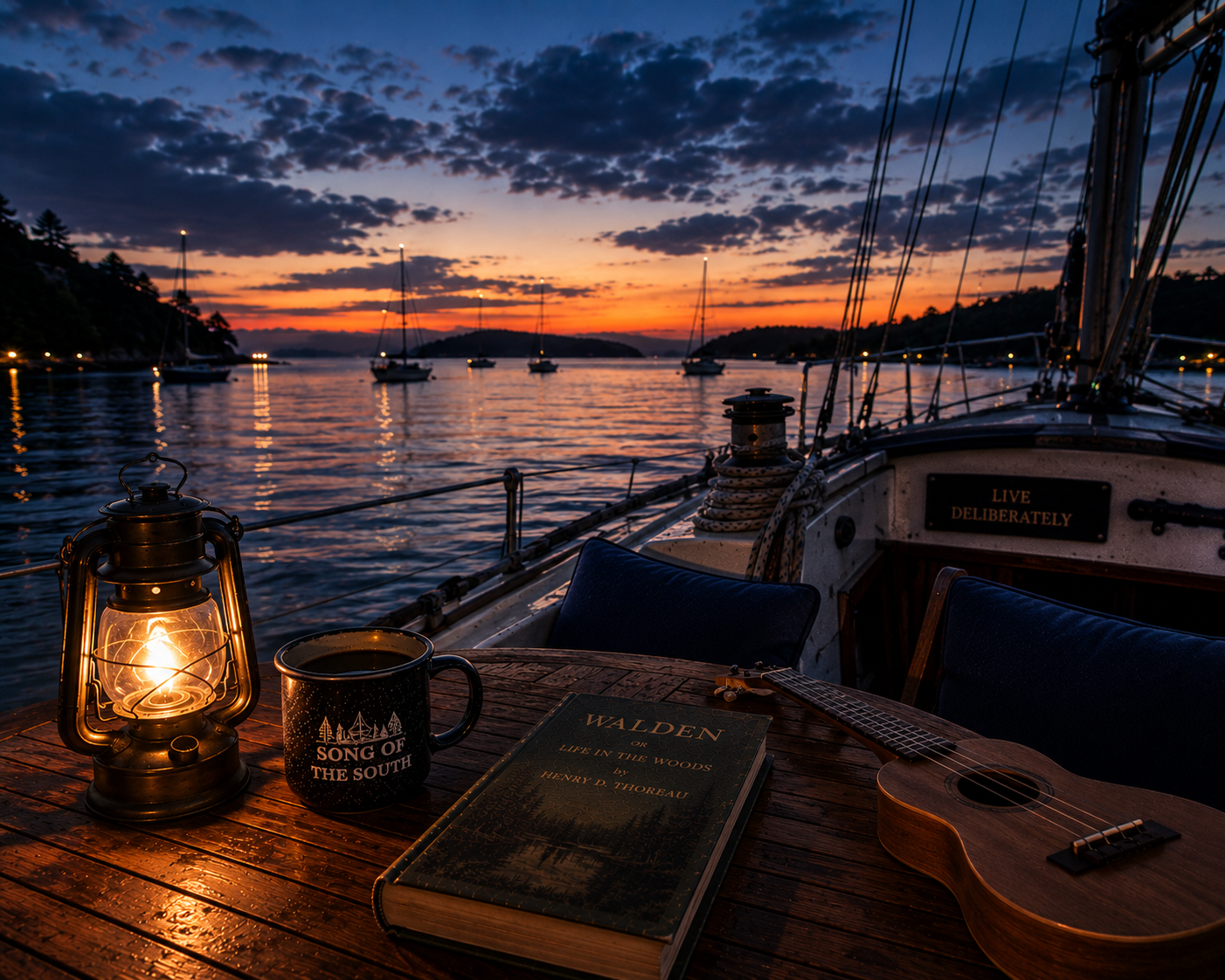
The harbor changes after dark.
During the day there is always something happening.
Engines start. Dinghies move back and forth. Somebody is working on something. Somebody else is looking for a tool. Radios crackle. Boats arrive. Boats leave.
Then evening comes.
One by one, the noises disappear.
The water settles.
A few anchor lights come on.
And eventually there isn’t much left except the sound of water against the hull.
I have always liked that time of night.
Maybe that’s why Henry David Thoreau has been good company this week.
Most people know the broad outline of his story. In 1845, Thoreau went to live in a small cabin near Walden Pond in Massachusetts. He stayed there a little more than two years and later wrote Walden about the experience.
It is tempting to reduce the whole thing to a story about simple living.
Own less.
Need less.
Get away from civilization.
There is some of that in there.
But I think Thoreau was after something considerably more important.
He wanted to know what remained when the unnecessary things were removed.
He wrote that he went to the woods because he wished to “live deliberately.”
That word has stayed with me.
Deliberately.
Not efficiently.
Not successfully.
Not comfortably.
Deliberately.
There is a difference.
We accumulate more than possessions
Living aboard a sailboat teaches you fairly quickly that space matters.
Everything you bring aboard has to go somewhere.
Eventually you begin asking a useful question before adding something new:
Does this deserve the space it will occupy?
I wish we asked that question about more than possessions.
Because over a lifetime, we accumulate an awful lot of other things.
Expectations.
Obligations.
Old arguments.
Other people’s definitions of success.
The need for approval.
The need to be right.
Schedules so full that we begin confusing activity with purpose.
None of these things take up much room in a locker.
They can take up an enormous amount of room in a life.
Thoreau wrote that a person is rich “in proportion to the number of things which he can afford to let alone.”
The older I get, the more sense that makes.
Maybe wealth isn’t only measured by what we can acquire.
Maybe some of it is measured by what we no longer need.
The schedule occasionally needs to lose
I was reminded of that today.
I had things I intended to accomplish.
Then there was sunshine.
There were friends.
There was sake.
The afternoon stretched a little longer than planned.
And the schedule lost.
Years ago, that might have bothered me more than it does now.
We are taught to manage time carefully.
Make the day productive.
Get things done.
There is nothing wrong with any of that. Boats certainly don’t maintain themselves, and life comes with responsibilities whether we feel philosophical about them or not.
But there is a difference between wasting time and spending it well.
An afternoon with friends may produce absolutely nothing you can put on a spreadsheet.
It may still be one of the better uses of the day.
Thoreau didn’t simplify his life so he could become more efficient.
He simplified it so he could become more alive.
That’s worth remembering.
Attention may be the real currency
This morning I found myself thinking about another part of Thoreau’s life that we sometimes overlook.
The man paid attention.
He noticed ice.
Birds.
Trees.
Weather.
Water.
Seasons.
Things most people walked past without giving them much thought.
Perhaps that was part of his experiment too.
When you remove some of the noise, ordinary things become interesting again.
A cup of coffee before sunrise.
Rain hanging from the rigging.
The first breeze touching the water.
A conversation that lasts longer than expected.
A cigar.
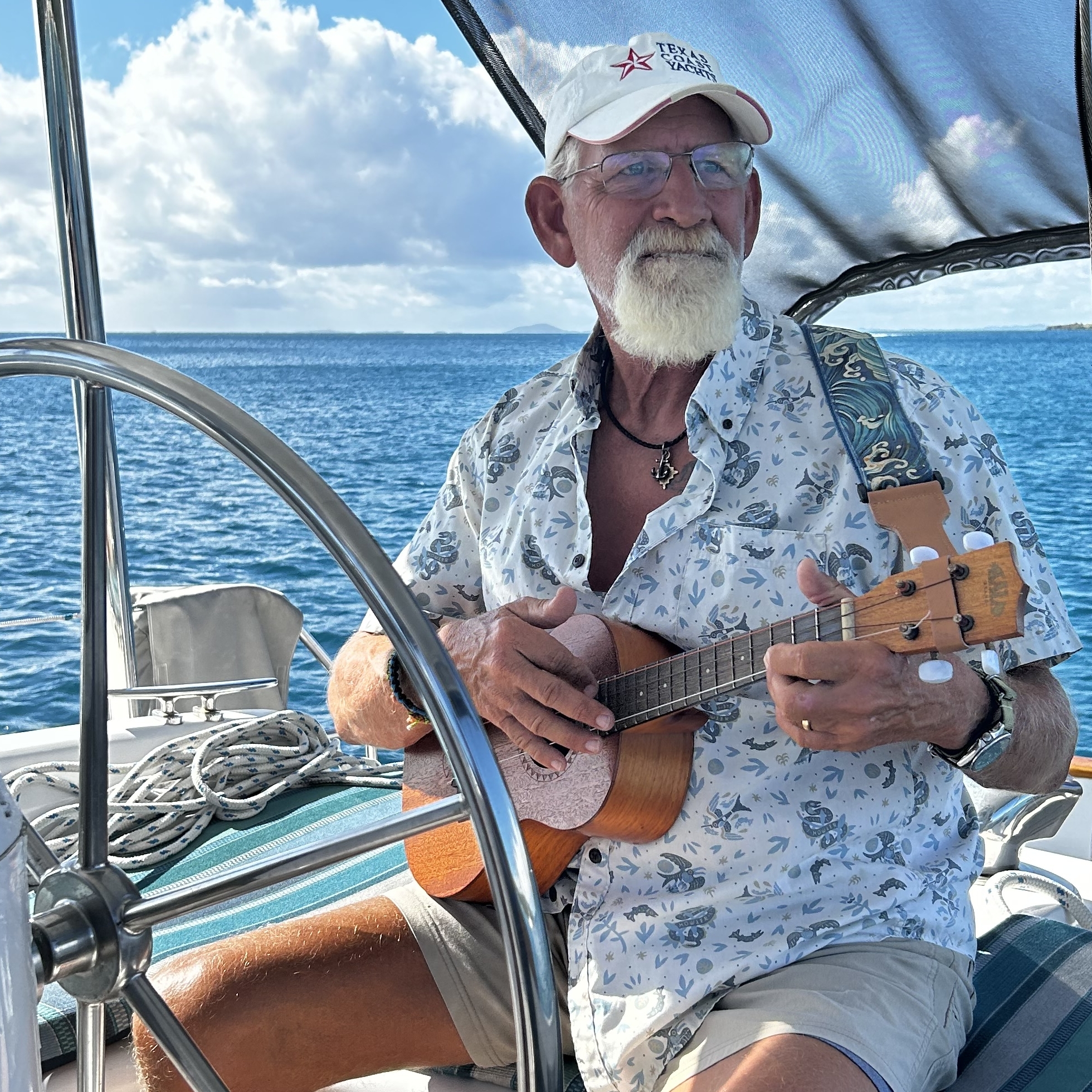
A badly played song on a ukulele that is getting slightly less badly played.
None of these things will make history.
That’s precisely the point.
A life isn’t lived mostly in the extraordinary moments.
It is lived here.
In the ordinary ones.
And the ordinary is only ordinary when we stop noticing it.
Then the harbor gets quiet
Which brings me back to tonight.
The day eventually gives up its demands.
The harbor settles.
And there comes a moment when there isn’t much left to distract us.
That kind of quiet can be uncomfortable.
Because once everything else stops talking, we occasionally hear questions we have managed to avoid.
Am I living the life I actually wanted?
What am I carrying that I could finally put down?
Whose approval am I still trying to earn?
What am I waiting for?
Thoreau valued solitude because solitude creates room for those questions.
Not loneliness.
Solitude.
There is an important difference.
Loneliness is wishing someone else were there.
Solitude is discovering that being alone with yourself isn’t necessarily an empty room.
Thoreau wrote:
“I never found the companion that was so companionable as solitude.”
I think I understand what he meant.
Quiet doesn’t necessarily give us answers.
It gives us a chance to hear our own.
Live deliberately
There is a small irony in writing about deliberate living.
It can easily become another thing to accomplish.
Another philosophy to master.
Another list of habits we’re supposed to adopt.
I don’t think Thoreau needs that from us.
You don’t need to move to Walden Pond.
I don’t need to sell the boat and build a cabin in the woods.
We probably don’t need to throw away everything we own.
Maybe we just need to pay better attention.
To what we carry.
To what we chase.
To whose drummer we’re following.
To the people sitting beside us when the afternoon runs longer than expected.
To the morning happening outside while we’re busy planning tomorrow.
And every once in a while, when the harbor gets quiet, to the person sitting there when everything else has gone silent.
There is still plenty I want to do.
Places I want to see.
Things I want to learn.
Horizons I haven’t crossed yet.
Thoreau hasn’t convinced me to stop wanting any of that.
If anything, he has reminded me why I want it.
I don’t want merely to pass the time allotted to me.
I would like to notice it.
I would like to choose some of it.
And when possible, I would like to spend it well.
Perhaps that’s all living deliberately ever meant.
The harbor is quiet now.
That’s enough for tonight.
Fair winds, my friends.