A while back, I came across a simple metaphor that stayed with me:
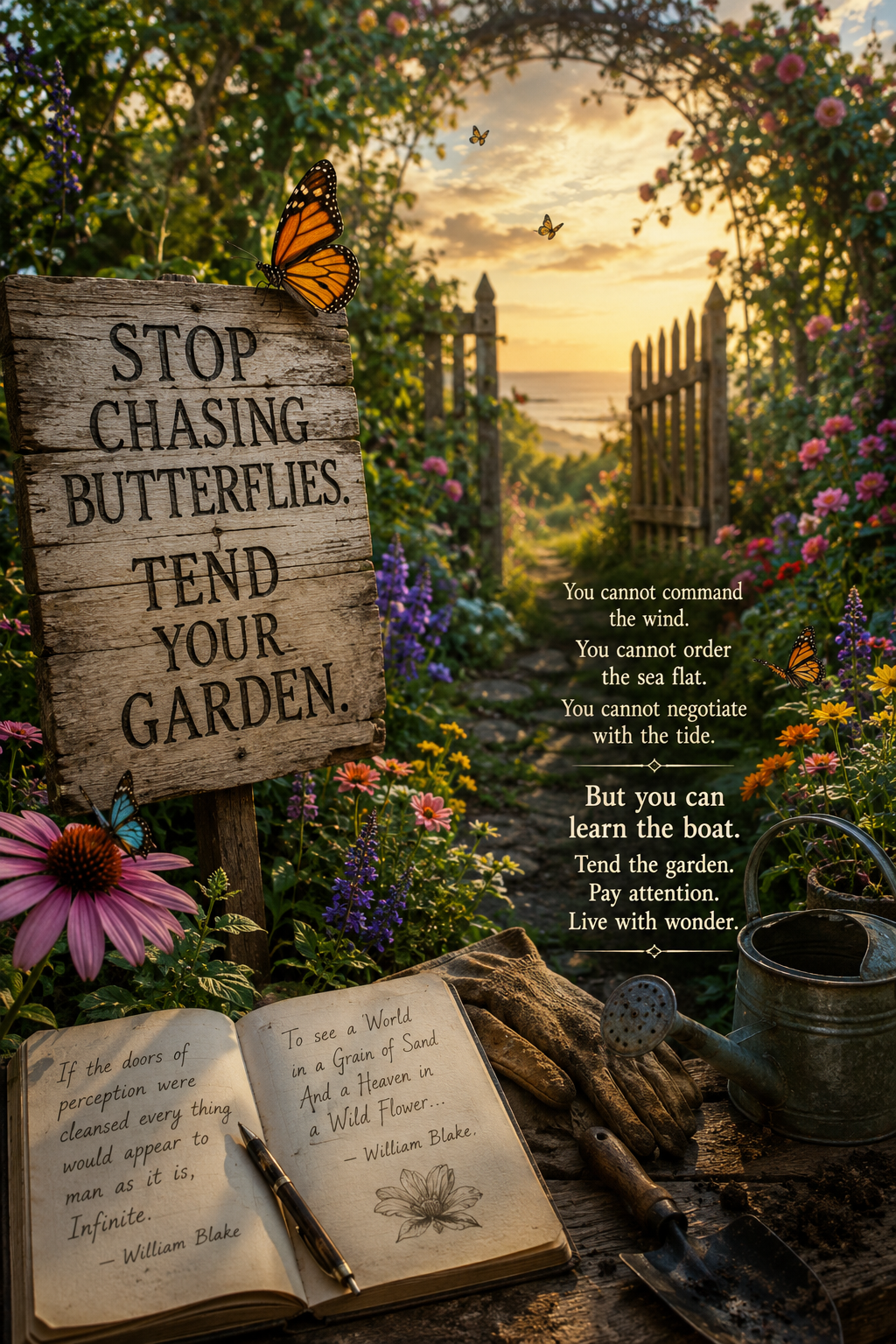
Stop chasing butterflies. Tend your garden.
The idea is straightforward enough. We spend a remarkable amount of our lives chasing things—success, happiness, relationships, recognition, money, some imagined version of ourselves we think we ought to become.
We chase the butterflies.
And anyone who has ever watched a child chase one knows how that usually works. The harder you run after it, the farther away it seems to flutter.
But tend a garden well enough, and sometimes the butterflies come on their own.
I’ve been thinking about that again this week as I’ve spent some time with Taoism.
The Tao Te Ching repeatedly brings us back to something that is remarkably difficult for people like me to accept:
Not everything needs to be pursued.
Not everything needs to be improved.
Not everything needs to be forced.
There is wu wei—often translated as “non-action,” although I think that translation can mislead us. It isn’t sitting around waiting for life to happen. It is acting without unnecessary force. Working with the nature of things instead of constantly trying to bend them to our will.
Tend the garden.
Water what needs watering.
Pull a few weeds.
Then leave the damn flowers alone.
And that brought me back to William Blake.
Blake certainly wasn’t a Taoist. He was an English poet, artist, mystic, and visionary living half a world and a couple thousand years removed from Lao Tzu.
Yet Blake wrote something that seems strangely at home beside the Tao:
“If the doors of perception were cleansed every thing would appear to man as it is, Infinite.”
Maybe our problem isn’t always that life lacks the things we’re searching for.
Maybe sometimes we simply aren’t seeing them.
We become so occupied with chasing the next butterfly that we stop noticing the garden we’re already standing in.
That thought changes the metaphor for me.
At first, “tend your garden” sounds almost transactional.
Improve yourself and good things will come.
Become successful and opportunities will appear.
Heal yourself and the right people will find you.
Do the work and eventually the universe will reward you.
I’m not sure I believe that.
Life doesn’t owe us butterflies because we planted flowers.
A well-tended garden can still endure drought. Storms come. Plants die. People leave. Plans fail. Sometimes you can do everything right and still watch something you love disappear over the horizon.
The Tao doesn’t promise otherwise.
What cultivation can change is the person standing in the garden.
Patience changes.
Attention changes.
Desire changes.
And perhaps most importantly, perception changes.
We begin noticing things we once hurried past.
Blake wrote elsewhere of seeing “a World in a Grain of Sand” and “a Heaven in a Wild Flower.”
That isn’t really about the grain of sand.
It’s about the eyes looking at it.
And perhaps that’s where Blake and Lao Tzu unexpectedly shake hands.
One tells us to stop forcing the river.
The other tells us to clean the window.
Neither promises that life will arrange itself according to our wishes.
They suggest something much more interesting:
Perhaps we can learn to meet life as it actually is.
There is an old sailor’s lesson hiding in there too.
You cannot command the wind.
You cannot order the sea flat.
You cannot negotiate with the tide.
But you can learn the boat.
You can trim the sails.
You can pay attention.
And eventually you discover that sailing was never about making the ocean cooperate.
It was about learning how to move through it.
Maybe tending the garden is the same thing.
So plant something.
Water it.
Pull the weeds when they need pulling.
Sit quietly once in a while.
And if a butterfly happens to land nearby, enjoy the hell out of it.
But don’t spend your whole life running around the garden with a net.
You might miss the flowers.