There are moments at sea when philosophy gets very practical, very quickly.
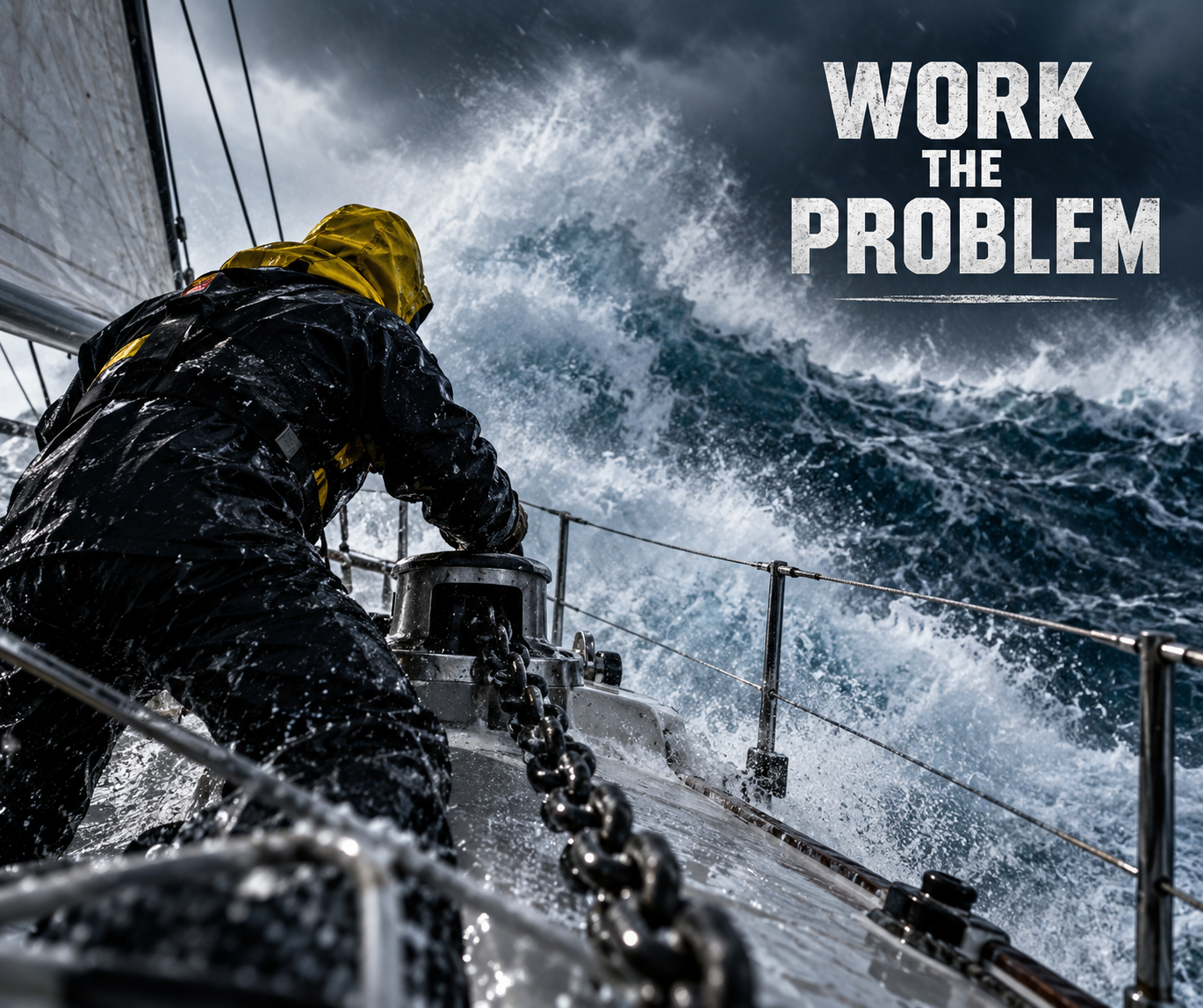
The seas are running twenty-five feet and the anchor chain jumps the wildcat. The keeper pulls out. Suddenly there is a hundred feet of heavy chain hanging beneath the boat while she pitches and rolls in conditions where simply standing on the foredeck is a challenge.
Or the steering goes out.
Not sluggish. Not acting funny.
Gone.
Those are interesting moments.
Because the problem doesn’t care whether you’re frightened.
It doesn’t care whether this is fair.
It doesn’t care that you maintained the equipment, checked the weather, made a good plan, or would really prefer to deal with this tomorrow.
The problem simply is.
And somewhere in those first few moments, a decision gets made.
Maybe not consciously.
You can spend your energy wishing reality were different.
Or you can work the problem.
⸻
The Stoics understood this remarkably well.
Epictetus began with one of the simplest distinctions in philosophy: some things are within our control and some things aren’t.
That sounds almost painfully obvious.
Until the steering goes out.
You cannot control the broken steering system. That has already happened.
You cannot control the seas.
You cannot control the wind.
You cannot negotiate with gravity, complain to the ocean, or vote for better weather.
But there are still things you can control.
What do we have?
What still works?
What’s the immediate danger?
What needs to happen first?
Can we slow the boat down?
Can we heave to?
Where’s the emergency tiller?
Who needs to do what?
Work the problem.
Not the problem you wish you had.
Not the problem you had yesterday.
Not the problem you might have tomorrow.
This one. Right now.
⸻
I’ve been thinking about that lately because problems don’t only arrive wearing foul-weather gear.
Sometimes they’re financial.
Sometimes they’re mechanical.
Sometimes they’re relationships.
Sometimes something you’ve poured time, money, energy, and belief into simply isn’t going the way you think it should.
Sometimes the numbers stink.
Sometimes the audience isn’t listening.
Sometimes the thing you know ought to be working simply isn’t.
And strangely enough, our first instinct is often to argue with reality.
This shouldn’t be happening.
Maybe not.
But it is.
That’s an important distinction.
Accepting reality isn’t surrendering to it.
When I accept that the steering has failed, I haven’t surrendered the boat.
I’ve simply stopped wasting precious energy pretending I still have steering.
Now I can do something useful.
⸻
Marcus Aurelius wrote about the obstacle becoming part of the way forward.
I’ve always liked that idea, but life has taught me something else about obstacles:
They have a way of making things simpler.
When everything is working, there may be twenty things competing for your attention.
When something important breaks, suddenly there are only three.
Then two.
Then one.
What needs doing now?
Do that.
Then look around again.
Conditions may have changed.
Your first solution may not have worked.
Fine.
What do we know now that we didn’t know five minutes ago?
Work the problem again.
⸻
Maybe that’s why Stoicism has always made sense to me.
At its best, it isn’t about becoming emotionless.
Fear is real.
Frustration is real.
Disappointment is real.
So is exhaustion.
The Stoic question isn’t whether you feel those things.
It’s whether you are going to hand them the helm.
You can be scared and still think.
You can be disappointed and still act.
You can be exhausted and still identify the next useful thing.
You can even fail.
And then work the problem from there.
⸻
Over the next week, I want to explore that idea.
We’ll spend some time with Epictetus, Marcus Aurelius, Seneca, and probably a few others.
But mostly I want to look at what happens when philosophy leaves the bookshelf and meets real life.
When the plan fails.
When something breaks.
When the numbers don’t work.
When the weather changes.
When you’ve tried what you thought would work and it didn’t.
Because sooner or later, every one of us ends up standing on our own version of that pitching foredeck.
And reality asks a remarkably simple question:
Okay. This is where we are.
What are you going to do next?
Work the problem!