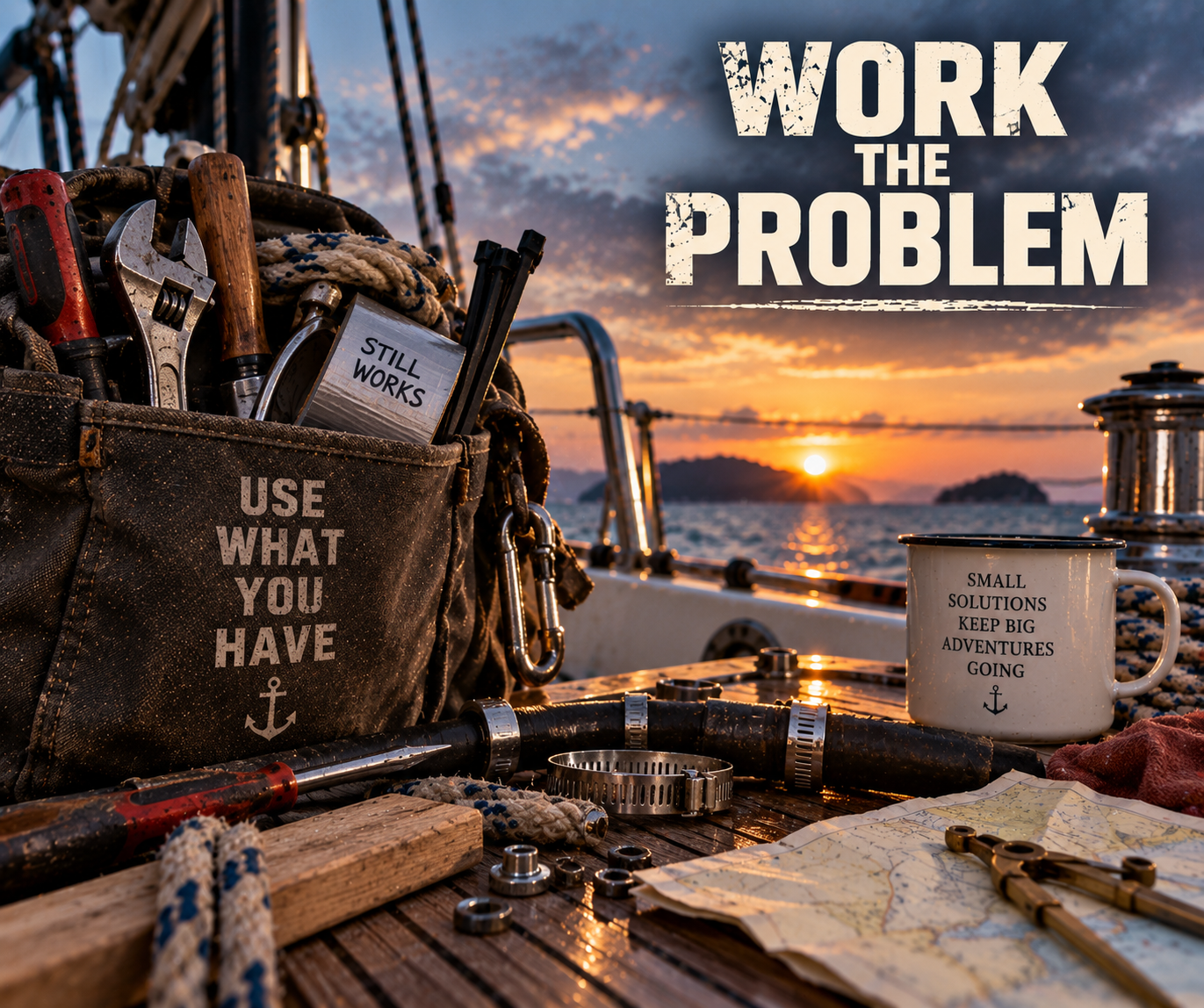
Captain Michael: WORK THE PROBLEM
Sometimes the right tool isn’t aboard.
That’s inconvenient.
The problem generally doesn’t care.
At
WORK THE PROBLEM
Sometimes the right tool isn’t aboard.
That’s inconvenient.
The problem generally doesn’t care.
At sea, there comes a moment when you’ve opened every locker, checked the spares, dug through the toolbox twice and finally accepted:
We don’t have what we need.
Or at least not what the manual says we need.
Now things get interesting.
Because the question changes.
It is no longer:
What should I have?
It becomes:
What do I have?
A length of line.
A hose clamp.
Some wire.
A piece of wood.
Duct tape, naturally.
And probably three things whose manufacturers never imagined they’d someday be lashed together to keep a sailboat moving.
That’s not recklessness.
There’s a difference between a dangerous shortcut and a sound temporary solution.
A sailor learns to know that difference.
The Stoics understood something similar.
They didn’t promise ideal circumstances.
They asked what a person could do with the circumstances actually given to them.
That’s where ingenuity begins.
We do this in the rest of life too.
We postpone starting because we don’t have enough money.
Enough knowledge.
Enough people.
Enough time.
Enough certainty.
Sometimes those limitations are real.
But sometimes “I don’t have what I need” is simply another way of saying:
“I don’t have what I wish I had.”
Those are not the same thing.
So inventory what you’ve got.
Skills.
Experience.
Friends.
Tools.
Time.
A phone.
A pencil.
A stubborn streak.
Maybe even an old sailor who has seen something similar before.
Then ask:
What can I build from here?
You may not have the perfect solution.
You may only have enough to get through tonight.
Sometimes that’s plenty.
Use what you have.
Do what you can.
Work the problem.
#WorkTheProblem, #Stoicism, #StoicWisdom, #Resourcefulness, #Resilience, #ProblemSolving, #LifeWellLived, #SeekingAWellLivedLife, #CrypTok
Captain Michael: WORK THE PROBLEM Sometimes the right tool isn’t aboard. That’s inconvenient. The problem generally doesn’t care. At sea,
WORK THE PROBLEM Sometimes the right tool isn’t aboard. That’s inconvenient. The problem generally doesn’t care. At sea, there comes a moment when you’ve opened every locker, checked the spares, dug through the toolbox twice and finally accepted: We don’t have what we need. Or at least not what the manual says we need. Now things get interesting. Because the question changes. It is no longer: What should I have? It becomes: What do I have? A length of line. A hose clamp. Some wire. A piece of wood. Duct tape, naturally. And probably three things whose manufacturers never imagined they’d someday be lashed together to keep a sailboat moving. That’s not recklessness. There’s a difference between a dangerous shortcut and a sound temporary solution. A sailor learns to know that difference. The Stoics understood something similar. They didn’t promise ideal circumstances. They asked what a person could do with the circumstances actually given to them. That’s where ingenuity begins. We do this in the rest of life too. We postpone starting because we don’t have enough money. Enough knowledge. Enough people. Enough time. Enough certainty. Sometimes those limitations are real. But sometimes “I don’t have what I need” is simply another way of saying: “I don’t have what I wish I had.” Those are not the same thing. So inventory what you’ve got. Skills. Experience. Friends. Tools. Time. A phone. A pencil. A stubborn streak. Maybe even an old sailor who has seen something similar before. Then ask: What can I build from here? You may not have the perfect solution. You may only have enough to get through tonight. Sometimes that’s plenty. Use what you have. Do what you can. Work the problem. #WorkTheProblem, #Stoicism, #StoicWisdom, #Resourcefulness, #Resilience, #ProblemSolving, #LifeWellLived, #SeekingAWellLivedLife, #CrypTok
WORK THE PROBLEM Sometimes the right tool isn’t aboard. That’s inconvenient. The problem generally doesn’t care. At sea, there comes a moment when you’ve opened every locker, checked the spares, dug through the toolbox twice and finally accepted: We don’t have what we need. Or at least not what the manual says we need. Now things get interesting. Because the question changes. It is no longer: What should I have? It becomes: What do I have? A length of line. A hose clamp. Some wire. A piece of wood. Duct tape, naturally. And probably three things whose manufacturers never imagined they’d someday be lashed together to keep a sailboat moving. That’s not recklessness. There’s a difference between a dangerous shortcut and a sound temporary solution. A sailor learns to know that difference. The Stoics understood something similar. They didn’t promise ideal circumstances. They asked what a person could do with the circumstances actually given to them. That’s where ingenuity begins. We do this in the rest of life too. We postpone starting because we don’t have enough money. Enough knowledge. Enough people. Enough time. Enough certainty. Sometimes those limitations are real. But sometimes “I don’t have what I need” is simply another way of saying: “I don’t have what I wish I had.” Those are not the same thing. So inventory what you’ve got. Skills. Experience. Friends. Tools. Time. A phone. A pencil. A stubborn streak. Maybe even an old sailor who has seen something similar before. Then ask: What can I build from here? You may not have the perfect solution. You may only have enough to get through tonight. Sometimes that’s plenty. Use what you have. Do what you can. Work the problem. #WorkTheProblem, #Stoicism, #StoicWisdom, #Resourcefulness, #Resilience, #ProblemSolving, #LifeWellLived, #SeekingAWellLivedLife, #CrypTok